Press Release
FOR IMMEDIATE RELEASE
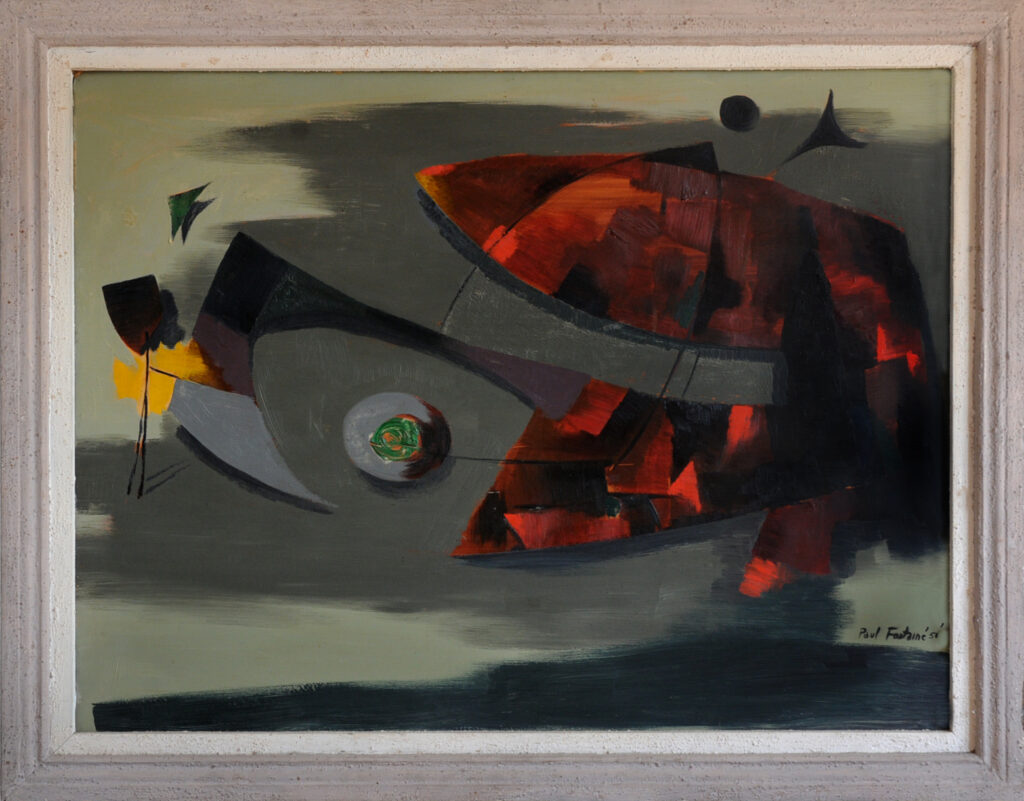
The Fontaine Archive Donates The Green Spot to Wiesbaden Museum
Austin, TX – The Fontaine Archive is delighted to announce the donation of The Green Spot, a captivating oil painting by Paul Fontaine, to the Wiesbaden Museum. Created in 1951, this significant artwork measures 100 x 77.5 cm and adds a vital piece to the museum’s collection.
The Green Spot was initially acquired in 1951 by journalist Eugen Kogon, a Holocaust survivor who escaped from Buchenwald concentration camp. Kogon, who was smuggled out in a coffin under the guise of being deceased from Typhus, later testified at the Buchenwald trials. He played an instrumental role in the reformation of Germany’s post-war government and authored The Theory and Practice of Hell: The German Concentration Camps and the System Behind Them, the first book published on the subject in 1946.
Kogon purchased the painting from the Frankfurter Kunstkabinett, a gallery organized by renowned German painter and patron Hanna Bekker. Virginia Fontaine noted in her diary on October 18, 1951, the excitement surrounding Kogon’s visit to view the artwork and his keen interest in acquiring it.
The granddaughter, Ruth Willis, describes the painting’s impact on the family, “The Green Spot hung in the living room above the grand piano that my grandmother sometimes still played. The painting always held a special place in the family’s heart—it symbolized hope and new beginnings.”
The painting remained within Kogon’s family until 2025, when his granddaughter sold it back to the Fontaine Archive. This donation to the Wiesbaden Museum reflects the ongoing collaboration between the museum and the Hanna Bekker vom Rath collection, and the Fontaine Archive, and their continued commitment to furthering the scholarship and understanding of post-war German Modernism.
Art historian Claudia Chidester describes The Green Spot as a representation of Fontaine’s artistic approach from the 1950s and 1960s. She remarks, “He created a composition with a singular focal point, usually a bright color, that feels like a beacon in a storm. His titles are never meant to influence the viewer on an emotional level, but direct the viewer—although the beacon can feel like a sign of hope in a particularly dark swirling environment.”
The donation of The Green Spot to the Wiesbaden Museum highlights the essential role of cultural preservation through museum contributions, which facilitate the safeguarding and exhibition of significant artworks for future generations. This not only ensures that these important pieces are maintained but also emphasizes the necessity of understanding the profound impact art had during the post-war period in Germany. By preserving and presenting such works, we can continue to explore the vital contributions of the artistic community during this transformative era. These contributions reflect the resilience and creativity that emerged in the aftermath of conflict, offering invaluable insights into the collective psyche of a nation grappling with its history. Supporting cultural preservation through donations allows us to bridge the gap between the past and the present, fostering a deeper appreciation for the narratives that shape our understanding of art and its significance in times of upheaval. This ongoing dialogue not only enriches our current cultural landscape but also ensures that future generations can learn from and connect with the complex history of their predecessors.
Dr. Roman Zieglgänsberger, Curator of Classical Modernism, Wiesbaden Museum, states, “The painting Green Spot complements our collection in the most excellent way! We own the largest Otto Ritschl collection, and we already own artworks by Heinz Kreutz, Bernard Schultze, Ernst Wilhelm Nay and Fritz Winter. This will enable the Wiesbaden Museum to present the evolution of painting after the Second World War toward Abstract Expressionism with even greater nuance. We are delighted by this wonderful gift.”
This donation also aligns with the Fontaine Archive’s mission to foster a vibrant, international community of historians, art historians, artists, and collectors dedicated to the study of postwar modernism in Germany, the United States, and Mexico. At the heart of this work is a sustained, scholarly commitment to stewarding the artistic legacy of Paul Fontaine through rigorous study of his art and the careful preservation of his extensive archive. By promoting collaboration and research within this community, we aim to deepen understanding and appreciation for the intricate narratives that define this pivotal moment in art history, ensuring that the contributions of artists like Fontaine continue to resonate and inspire.
For more information, please contact Fontaine Archive at information-at-fontaine.org or 512-415-1744.